

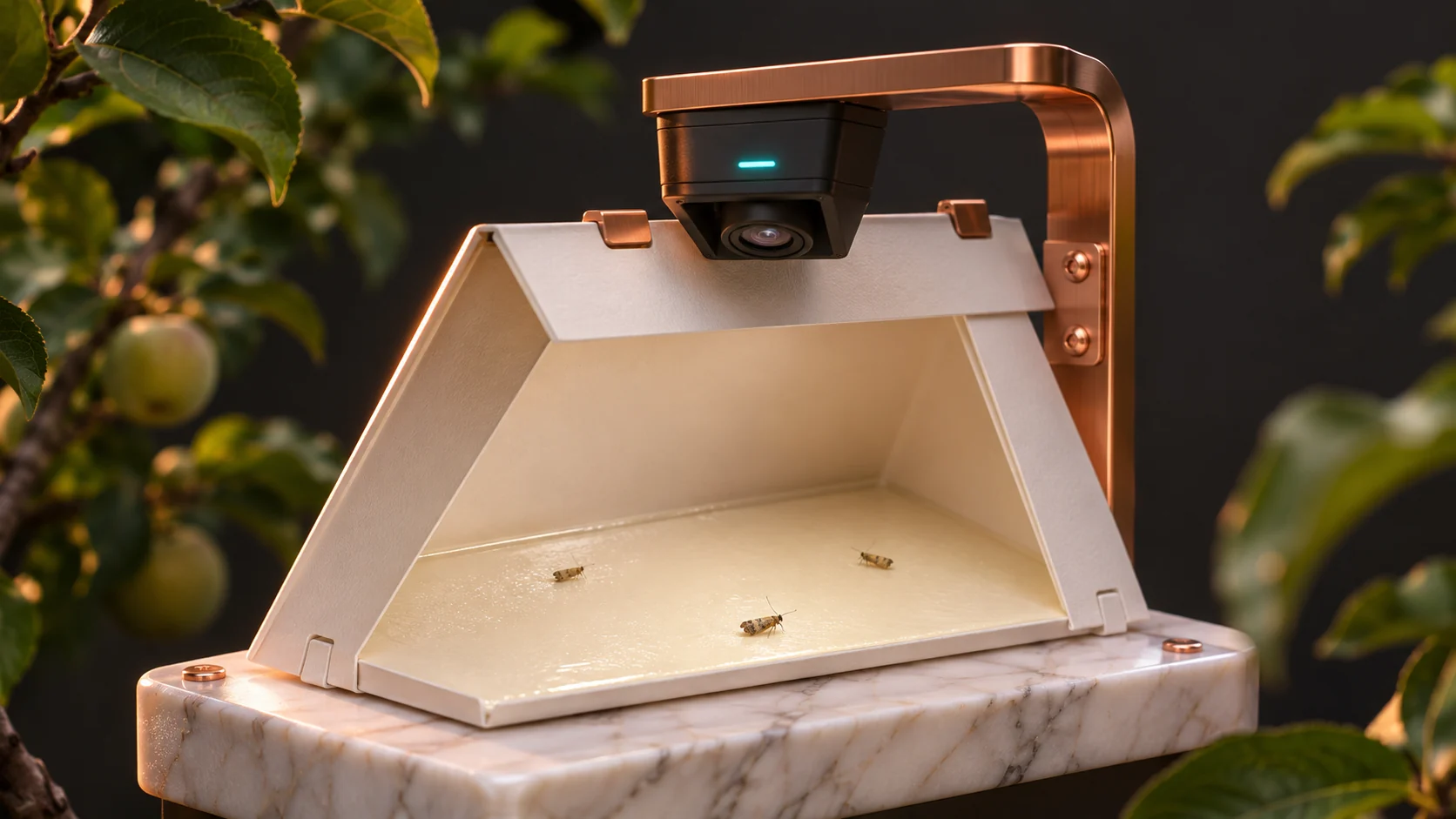
A camera over a pheromone trap can help a scout decide which traps to check first. To make that useful, it needs to show what changed since the last usable observation, flag questionable images, and let a person confirm the insects. A new catch is evidence of trap activity. It does not by itself measure crop damage or authorize a treatment.
This guide is for orchard managers, pest scouts, crop advisers and integrators. Start with one target species, one approved lure and a small group of traps that scouts already service. Use the camera to support the existing integrated pest management (IPM) program.
Preserve the scouting method and the lure context
Choose the trap, lure, placement and service routine with the crop adviser for the specific pest and crop. For example, a codling moth lure intended to attract males and a combination lure can produce different catch patterns. Trap height, location, age, neighboring blocks and mating disruption also matter. Keep lure type, installation and replacement dates, liner ID, block and trap position with the count. Check that the camera and light do not obstruct the trap entrance, alter lure placement, or make normal servicing harder. Compare with the existing trap before changing the setup across a block.
A scout should confirm unfamiliar shapes, non-target moths, partially visible specimens and debris. Keep a separate “uncertain” category and a way to see the original crop. Report catches per trap and observation interval, with lure and maintenance context. UC IPM’s codling moth guidance for apples explains how traps, fruit monitoring, degree-days and orchard practices work together. Use the relevant local guidance for a different crop or pest.
Make images comparable before choosing a model
- Fix the geometry. Mount the camera rigidly above the liner and use a fixed focus, target distance and scale. Include a reference mark away from the sticky area, and check focus and usable detail at the center and corners. A wide-angle lens may cover the liner and still leave small insects too soft at the edges. Verify the smallest useful feature in the actual crop, not from the sensor’s megapixel rating.
- Control the light. Use repeatable diffuse illumination to reduce glue glare and hard shadows. Test sunny and cloudy conditions, wet or dusty lenses, temperature swings and low battery. A regular capture time can make comparisons easier, but a fixed schedule alone cannot remove glare or recover a blocked view. Avoid changing exposure or focus between images without recording the change.
- Reject unusable images. Check for blur, obstruction, condensation, a moved liner, lost scale or a full sticky surface. Record “unreadable” or “not captured” separately from zero. Ask for service or a manual count when the device cannot see the liner reliably. The grower still needs regular lure and liner maintenance.
An ESP32-S3 can take scheduled still images using a supported camera, lens and memory configuration. Espressif’s camera driver documentation describes supported sensors, JPEG capture and PSRAM constraints. Capture and JPEG compression do not establish inference capacity. An ESP32-P4 is another candidate where a supported MIPI CSI and imaging pipeline fit. See Espressif’s camera hardware guidance. Benchmark the exact sensor, image resolution, decoded buffers, model and connectivity before buying field units.
Count new catches once and record service events
A model can report a count of visible candidates on the current liner. To estimate new catches, align the current image with the last accepted image of that same liner and match visible objects by their positions and appearance. Track the lineage of each comparison and save the capture timestamp, model version and reviewer’s correction. A simple difference between totals fails when a specimen is removed, obscured, moved, or reclassified.
Suppose Tuesday’s accepted image shows four target candidates and Wednesday’s shows seven. If four matches are clear and no service occurred, the three unmatched objects are new candidates since Tuesday. A scout reviewing the crops confirms two target moths and one lookalike. The verified interval count is two. If Wednesday’s image is blocked and Thursday’s is clear, Thursday can support a longer interval since Tuesday but cannot assign a catch to Wednesday. If the liner was replaced or insects removed, start a new comparison baseline and reconcile the service event with the scout’s log.
Distinguish cumulative visible count, estimated new catch, verified new catch and unknown intervals in the dashboard. A full or heavily overlapped liner can put a count outside the method’s usable range. Route that trap to a person and record service rather than extending the last result.
Choose where detection should run and prove it on new traps
A constrained model such as Edge Impulse FOMO estimates object centroids. It can be useful when insects are similar in size and spaced apart, but two touching insects can merge at the model’s output resolution. A YOLO-style object detector can produce bounding boxes and class scores. That does not establish that a particular model will fit or run well on an ESP32. Quantization changes resource use and can change accuracy. Compare the final exported model and input size on the actual device.
Start by deciding what must be processed locally. A field node can take a fixed image, run a quality check and queue a crop for review. Lightweight detection can run on-device if validated. If species identification or dense liners need more detail or compute, process crops on a gateway or a supported service. Measure battery draw across camera wake-up, light, inference, storage and Wi-Fi or cellular upload. Store pending images locally when the link is down. A count recovered later should retain its original capture time.
Keep whole traps, liners, and preferably a site or date range out of the training data for the final test. Adjacent pictures of the same liner can contain the same insects, so a random split of images overstates generalization. Ask trained scouts to label clean and difficult examples, including empty traps, lookalikes, debris and heavy overlap. Predefine how detections match reference marks and how you score image coverage and intervals with a service event.
For example, 90 of 100 planned images are usable, so image coverage is 90%. On the usable held-out intervals, scouts identify 60 new target insects. The model correctly flags 54, misses six, and flags three non-targets. Precision is 54 out of 57 flags, about 94.7%. Recall is 54 out of 60 target insects, or 90%. The ten unusable images need separate follow-up. These invented numbers show why a model score cannot substitute for field coverage or timely review.
Run a scouting pilot and define the next action
- Keep manual checks during the trial. Compare image counts with normal visits and record where each method had difficulty. Test a replaced liner, a failed upload, a moved camera and a dirty or nearly full trap. Make sure the dashboard never presents any of those as a confirmed zero.
- Make exceptions actionable. Give the scout the trap and liner IDs, time window, cropped evidence, and reason for review. Flag abrupt catch changes and poor image quality separately. Decide who verifies the result and when a field visit is needed.
- Use the approved IPM method. A verified catch can prompt a trap check, fruit inspection or review of biofix, the observed event used to start a local degree-day model. The crop adviser should determine that timing and any action using the correct crop, lure, local guidance and field evidence. Keep spraying decisions outside the camera workflow.
- Measure what improved. Compare time to review a new catch, confirmed misses, unusable intervals and service effort against the existing process. Include batteries, connectivity, labels, cleaning and ongoing model review before choosing a custom station or a supported commercial system.
A useful pilot helps scouts see which traps need attention sooner and makes each count traceable to an image or field check. Keep the confirmed field result as the decision record.