

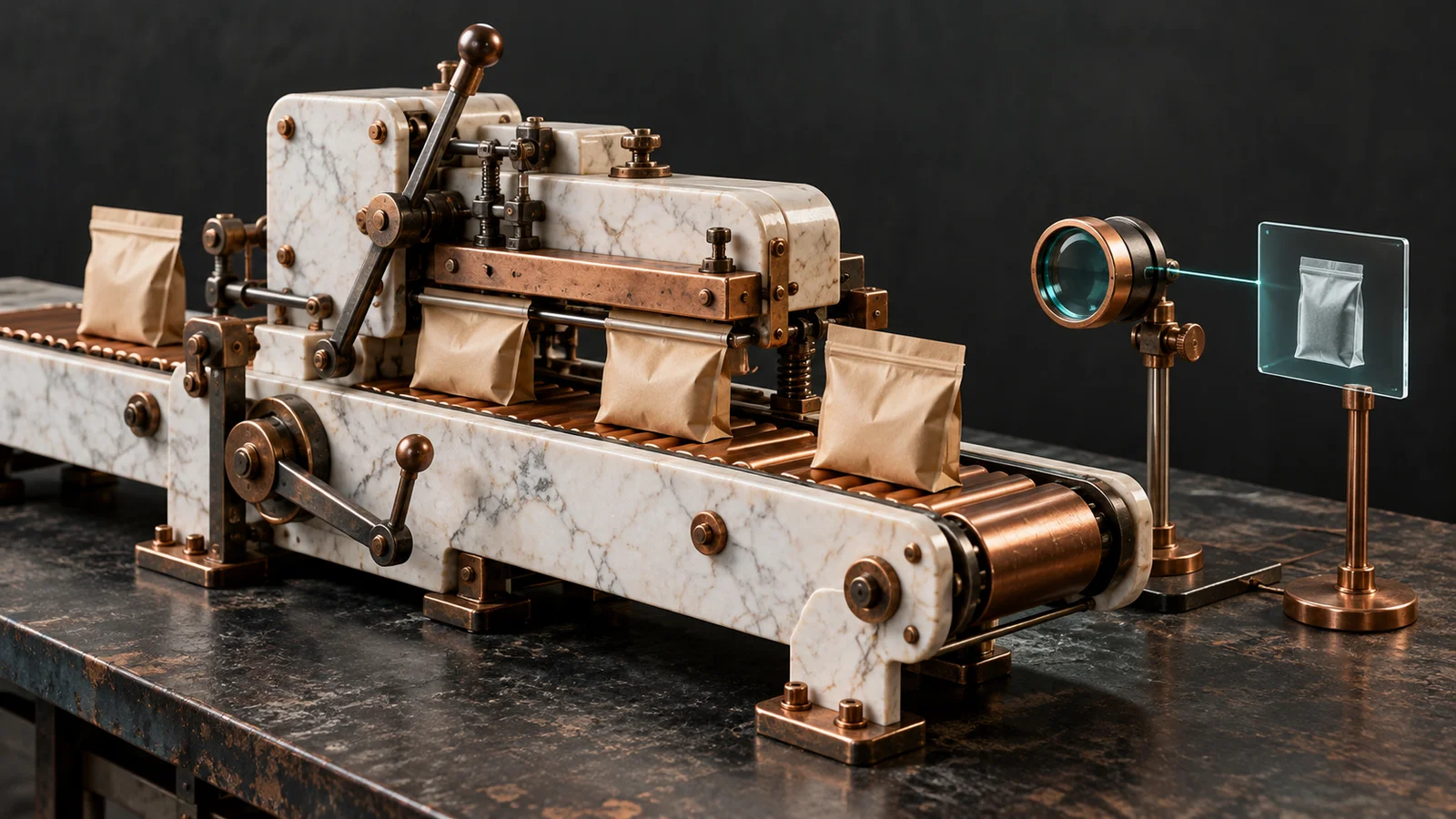
Modernize an older machine when it still meets the operating need and a supportable change can solve a specific problem. Start by separating missing information from missing machine capability. A counter may improve production reporting. It cannot repair worn sealing jaws, add capacity, or establish that a package is acceptable.
Consider a bag-sealing line whose mechanics remain useful but whose production history is poor. The investment decision is whether a modest observation layer is enough, a supported control upgrade is justified, or repair and replacement deserve priority. Age alone does not settle that choice.
Establish what is worth keeping
Ask production, maintenance, and quality what the machine can still do. Check actual product requirements, recurring defects, parts availability, and the work needed to keep it serviceable. A line that meets today's format may still be unsuitable for tomorrow's material or production volume.
| Question | Evidence to request |
|---|---|
| Can it make the required product? | Current quality records and format requirements. |
| Can it remain serviceable? | Condition review, repair history, and parts support. |
| What is missing? | A specific reporting gap or physical limitation. |
| Who will use the improvement? | A named owner and intended operating decision. |
For each row, record supported, unresolved, or unsuitable. Link the evidence and name its owner. An unknown is a request for investigation, not a positive finding.
The DOE's 2010 maintenance guide describes maintenance systems that retain work orders and equipment-related documentation. Those existing records can inform the feasibility review.
Keep condition findings separate from assumptions about useful life. If suitability or safety remains unresolved, record the open issue and the person qualified to assess it. A reporting project should not absorb an unexamined machine problem.
Compare the available paths to information
Inventory existing reports, controller identity, software versions, available drawings, and the supplier's documented interfaces. An interface is the defined way another system exchanges information. A familiar connector or protocol name is only a starting clue.
| Candidate path | Feasibility question |
|---|---|
| Existing report or export | Does it already provide the required information? |
| Supported controller interface | Is access supported for this exact configuration? |
| External observation | Can an approved observer see the event reliably? |
For a vendor-specific example, Beckhoff's OPC UA documentation describes read-only data symbols, or named data items, with stated TwinCAT 3 prerequisites. OPC UA is an industrial data-exchange standard. The example does not establish compatibility with a different controller or recommend that product.
A supported path still needs review of its effect on the machine and its support arrangements. External observation also needs engineering review. A sensor positioned outside a cabinet can still create access, mounting, cleaning, or maintenance problems. Document feasibility rather than treating either path as automatically harmless.
Map evidence to the people who can act
Keep a source map beside the proposed design. It should show where each statement comes from and who may turn it into an action. A bag passing a detector is an observation. Product acceptance and permission to change the machine belong elsewhere.
For the observation option, specify that its collector records events without sending machine commands. Read-only describes permitted interaction, not a complete safety assessment. Review physical effects and communications as well as permissions.
Retain the original control and protective functions as independent of the observer. If collection stops, existing operating procedures still apply, and the report shows unavailable information. Any proposal that changes control logic belongs in a separate engineering assessment.
Work through the bag-sealing choice
Hypothetical worked scenario
All identifiers, records, and quantities here are invented. Line PK-04 seals bags in a currently accepted format. Its controller offers a local display, but no supported reporting interface has been confirmed. Operations wants bag-passage counts by job and shift. Quality's accepted-output record remains separate.
For this comparison, assume both invented totals cover the same job and reporting interval. Individual bag identities have not been matched.
- Observed passages
- 120 events at the proposed counting point.
- Quality-accepted bags
- 114 bags in the comparison record.
- Difference
- 120 minus 114 equals a count gap of 6.
- What remains unknown
- Rejects, repeat passages, and unlinked bag identities.
An external counter could support that reporting question. The production supervisor would own reconciliation with job and quality records. It would not establish seal strength, diagnose a fault, or determine why every pause occurred. The count gap does not prove that six defective bags exist.
A second proposal would replace controller software to expose richer events. The team lacks the original project, a confirmed recovery route, and a support owner. That proposal is rejected for this project. Its apparent convenience does not resolve those gaps.
Feasibility record PK-04-F links the documentation review, proposed observation point, acceptance plan, and unresolved questions. In this scenario, the plant manager authorizes only the observation assessment. The asset register links that decision to the reviewed evidence.
If a required new bag format exceeds the sealer's physical capability, the team evaluates an engineered upgrade or replacement. If wear is the limitation, repair is also considered. Expanding the counter's scope cannot resolve either physical problem.
Agree what would make the option acceptable
Define representative cases before approving the observation option. Include supported bag formats, starts and stops, spacing changes, and any legitimate repeat passage. The question is whether the evidence remains useful under those conditions.
The production owner should agree the acceptable counting discrepancy and its calculation before testing. This is a purpose-specific reporting criterion, not a machine operating limit or a substitute for quality acceptance.
| Case | Required finding |
|---|---|
| Representative production | Observed events reconcile with an independent reference. |
| Ambiguous or repeat passage | Limitations remain visible; accepted output is not inferred. |
| Collector unavailable | Reporting shows a gap; machine functions remain unaffected. |
| Observer removed | Documented restoration leaves the machine serviceable. |
The security-monitoring guidance in NIST SP 800-82 Revision 3 calls for preserving operational functions. Apply that principle when assessing the observer.
Use approved observation and offline simulations for the relevant checks. Qualified personnel decide how tests may be conducted. Withhold acceptance when the comparison lacks common job and time coverage, or the observer's effect remains unresolved. Record unexplained differences and reject a result that hides them. A demonstration with one bag format does not establish performance across every product or operating condition.
Put support effort and unknowns on the page
Compare the effort of the complete options. Include engineering assessment, documentation, approved downtime, training, replacement parts, software upkeep, and eventual removal. The price of a counter or gateway is only one input.
- Recovery access
- Controls engineer confirms usable backups and a recovery route.
- Parts and service
- Maintenance checks availability and supplier support.
- Installation effort
- Engineering assesses access, cleaning, and approved work needs.
- Ongoing ownership
- Operations names who maintains the observer and its records.
- Exit effort
- Project owner establishes removal and documentation requirements.
An observation option needs a suitable location, a verified counting method, and someone to maintain it. Control work also needs recoverable software and validation of changed behavior. Replacement adds product qualification, operator training, and integration with the rest of the line.
Keep unknown effort visible until someone has investigated it. Ask suppliers to confirm support scope and any effects on service terms for the actual proposal. Do not assume that an existing warranty either survives every modification or automatically disappears.
Compare options over a common planning horizon. If a key unknown could reverse the choice, assign an owner and a specific evidence request before treating an early estimate as an investment case. A missing spare-part lead time remains unknown until it is confirmed.
Choose a scope you can defend
The feasibility review should end with a decision and its conditions. Keeping the machine, adding observation, engineering a control upgrade, and replacing equipment are distinct outcomes. A useful review can also justify waiting for missing evidence.
- Can the machine meet the need? If not, assess repair, an engineered upgrade, or replacement first.
- Can an approved information path close the gap? If yes, evaluate that bounded option.
- Would control or physical capability need to change? Compare a supported engineered upgrade with repair or replacement.
- Can the chosen option be supported? Record the owner, conditions, and next decision.
Ordinary software can collect events and reconcile records. Optional AI may help compare approved manuals and maintenance notes, with references that a reviewer can inspect. It cannot supply missing approval, issue machine commands, or approve a safety design.
For PK-04, the next step is a bounded feasibility assessment of the counter. The unsupported controller change stays outside it. A future supported upgrade would need its own evidence and approval. Bring the worksheet, current machine records, and open questions to production, maintenance, controls engineering, and quality before ordering hardware.