

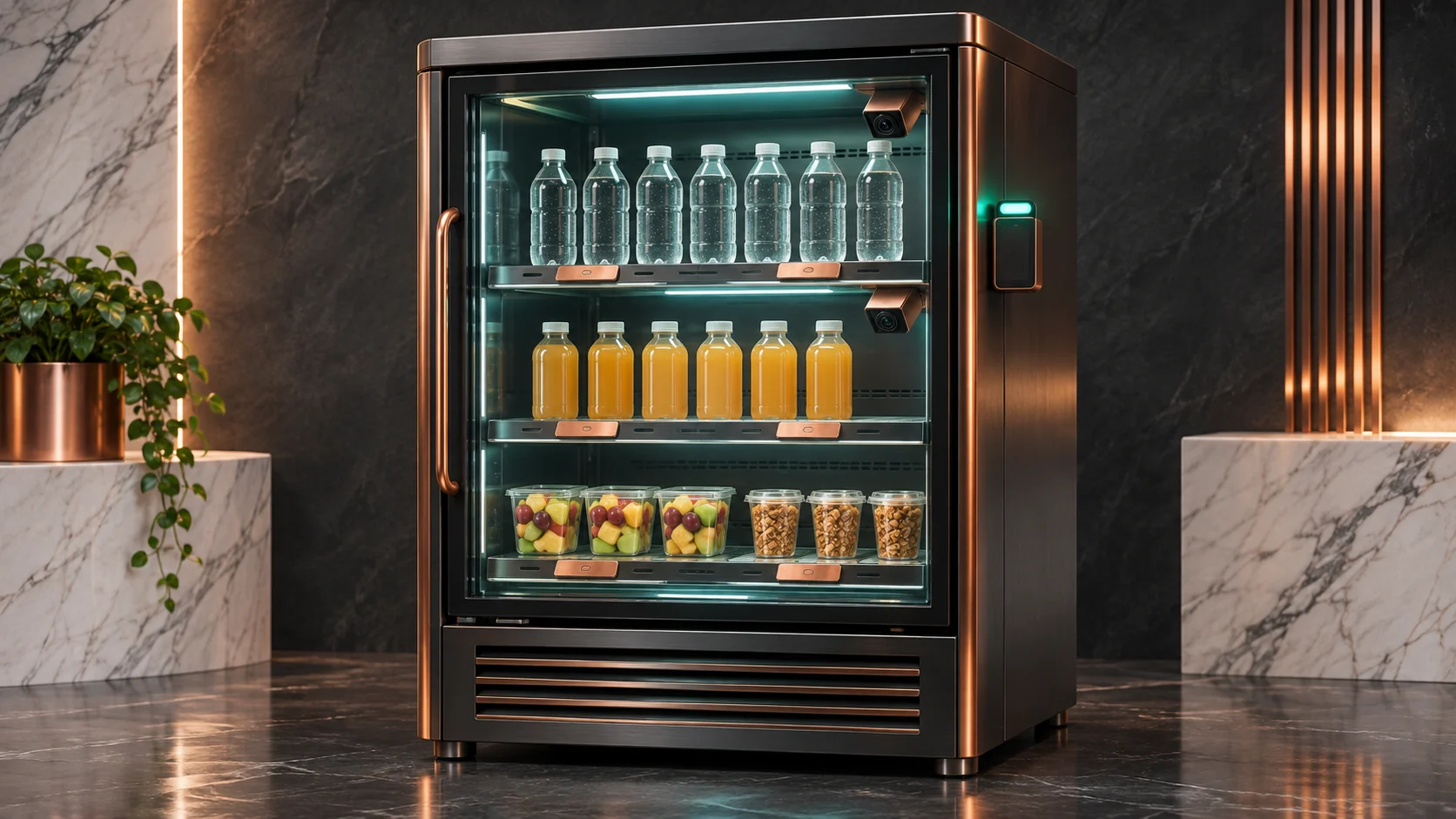
A grab-and-go cooler should charge only for a basket it can resolve with reliable evidence. A weight change tells you how much mass moved. A shelf camera can help identify what moved and where it went. If similar packages, an item return, or a blocked camera leave two plausible baskets, send the session to review instead of charging the more expensive guess.
This guide is for micro-market and vending operators, facilities teams, and integrators considering a retrofit. Start with a single cooler and a narrow product mix. Test the uncertain purchases as carefully as the easy ones.
Measure what moved and where it went
Start with mechanically separate trays or lanes. Give each a known location and permitted SKUs, then record gross package weight ranges from actual stock. Leave enough clearance that a tray, box or bottle cannot rest on the cabinet, the adjacent tray or a cable. If the intended products overlap in weight, designate one SKU per lane, use a barcode check, or plan a second identifying signal.
- Load cells and conversion. A strain-gauge bridge changes its small differential voltage under load. Use a suitable ratiometric bridge ADC, such as the TI ADS1232, at the shelf electronics. The ADC’s 24-bit word does not establish usable weight resolution. Calibrate zero and known loads at several points across the tray, then measure noise, settling, off-center error, drift after restocking, and behavior in the cold. A door slam or customer leaning on a tray can make readings briefly unusable. Set the decision band from measured error and package variation.
- Distributed shelf electronics. For several shelves, digitize close to the bridge and carry timestamped readings, sensor health and tray IDs to the host over a designed digital link such as RS-485. RS-485 supplies the electrical link, so choose a polling or messaging protocol and test wiring, termination and recovery from a disconnected node. If multiplexing channels, allow settling after switching and measure whether the resulting sampling cadence can separate rapid removals and returns. Compare stable pre-open and post-close plateaus as well as intermediate events.
- Camera evidence. Use fixed light, a rigid camera mount and defined shelf regions. A 2 MP sensor may show which slot changed while still failing to distinguish two similar packages at the frame edge or behind a hand. Test glare, condensation, overlapping products, dark packaging and blind corners. A door contact identifies opening and closure. A separate latch status, where available, helps distinguish a closed door from a confirmed locked state. Treat stale or contradictory signals as evidence gaps.
An ESP32-P4 can collect events and capture camera evidence. Espressif documents one native MIPI CSI camera controller path, alternative camera interfaces, and P4 hardware JPEG encoding. For two viewpoints, evaluate a second supported interface, a separate camera node, or a gateway before specifying hardware. Two CSI lanes do not provide two independently connected cameras. Prove capture timing and bandwidth on the exact combination. A separate ESP32-C6 can provide wireless connectivity where useful. Start with event-triggered shelf crops and restrict field of view, access and retention. Keep card terminals, faces, and adjacent spaces outside the camera view wherever practical.
Work through a removal followed by a return
Consider a training session with two permitted drinks. A sparkling water costs $2.50 and its tested gross package weight is 350–358 g. An energy drink costs $4.00 and weighs 352–362 g. Suppose the measured uncertainty for a settled tray difference is ±5 g. A 355 g decrease is consistent with either item. The two products should never be distinguished by that weight change alone.
The customer removes the sparkling water from tray A and puts it back. The tray returns to its starting range and a clear shelf frame confirms the slot is occupied. The customer then removes an energy drink from tray B. Tray B settles 356 g below its start. If the camera shows the identified energy drink slot empty, the current slot assignment has been verified, and the door and sensors are healthy, that is evidence for one $4.00 item and no sparkling water. If the customer returned the first can to the wrong tray or a hand obscured the decisive frame, the system must check whether a different basket still fits before approving payment.
Keep the evidence for one session together. Score candidate baskets using signed weight changes by tray, known package ranges, camera changes, and plausible returns or swaps. Require one supported result plus healthy sensors and sufficient separation from alternatives. Check that a candidate is feasible before comparing any model scores. Calibrate acceptance on labeled sessions. If neither basket can be ruled out, or the pre-open baseline is missing, send the case to review. Use clear wording about the pending hold and provide a support reference. The weights and prices above are invented examples for test design.
Separate door access, basket approval, and payment
- Before opening. Check that the cooler is available, its baseline is current, and no other purchase or service session owns it. Use an approved unattended payment terminal and provider flow to request a disclosed authorization hold where supported. Record a durable session ID and provider reference. An authorization reserves funds under the provider’s rules. Capture happens after the basket is resolved.
- While the door is open. Keep a single session linked to this cooler. Detect a held-open door and record open and close times. Use a separate, auditable service mode for restocking and inventory adjustments. Have the equipment manufacturer and site reviewer specify locking, power-failure, and emergency or service behavior. Keep lock power and protection off the microcontroller GPIO. Require an independently confirmed door or latch state where the design depends on it.
- After closure. Wait for a settled baseline, reconcile observations, then save the chosen basket or the pending-review state. Capture through the provider only when the approved basket and authorization permit it. Recover an interrupted capture by reconciling the original provider payment reference before issuing another request. Use operation-specific idempotency, verify provider events, and retain the final captured amount and receipt reference.
- When something is uncertain. Make the hold and review timeline visible. Follow provider rules for expiration, partial capture, reversal or release. If the total exceeds the approved hold, use a provider-supported flow with any required customer action or send the session for review. Do not continue charging later without a valid authorization. A legacy MDB cash or card interface may fit some vending equipment, but it does not by itself establish a variable-basket or preauthorization-and-capture workflow.
Use a provider integration that keeps raw card and PIN data outside the cooler controller. Stripe’s authorization and capture documentation illustrates how hold rules vary. The PCI Security Standards Council terminal guidance explains why device approval alone cannot establish compliance. Verify unattended use, terms, and the actual payment boundary with your provider and acquirer.
Keep refrigeration and food-safety controls independent
Keep the approved refrigeration controller and required food-safety protections in charge. A separate temperature feed can give the pilot read-only evidence of cabinet conditions, but should not replace the required monitoring, shutoff or restart procedure. Have the operator and local authority establish how the unit is classified, which foods are allowed, and what happens after a temperature excursion, failed probe or power loss. Where automatic vending shutoff is required, it must function independently of payment and the basket model. The FDA Food Code is a model code, so confirm the adopted rules and applicable equipment requirements. Test offline operation with the protective controls intact, and verify that an incident remains visible for staff follow-up.
Prove billing accuracy and decide whether to retrofit
- Run without automatic charging first. Compare proposed baskets with an independently recorded ground truth. Include similar-weight items, identical packages with different flavors, two removals at once, returns to the wrong tray, door vibration, camera obstruction and restocking mistakes. Include varying basket sizes and missing evidence.
- Measure accuracy and coverage separately. Suppose 180 of 200 scripted sessions produce an automatic basket and 179 of those 180 match the reference. Automatic coverage is 90%. The proposed baskets agree with the reference 99.4% of the time among the automatically resolved sessions. One would still have charged incorrectly, and the 20 held sessions require a separate workload measure. Investigate the wrong basket before enabling automatic capture. The figures are illustrative, and a staged test does not establish a live error rate.
- Exercise bad states. Interrupt the network after authorization, reboot after closure, replay a capture notification, disconnect a shelf node, simulate a stale door status, and verify the recovery queue. Measure time to receipt, false holds, disputed charges and staff effort as well as basket accuracy. Set acceptance thresholds with the operator and compare them against independent audit samples after launch.
- Compare installed alternatives. A barcode self-checkout is often easier to support when the product mix changes frequently or evidence remains ambiguous. Fixed single-SKU lanes can simplify a weight-based design. A commercial cooler may be the better option when it comes with supported equipment, payment integration, and service coverage. Compare enclosure changes, food-safety review, installation, cleaning, support, refunds, monitoring and payments across the choices.
A useful pilot tells you which baskets can be billed confidently, which require staff review, and what it costs to operate both paths. Use that result to decide whether to buy, retrofit, or keep the simpler checkout.