

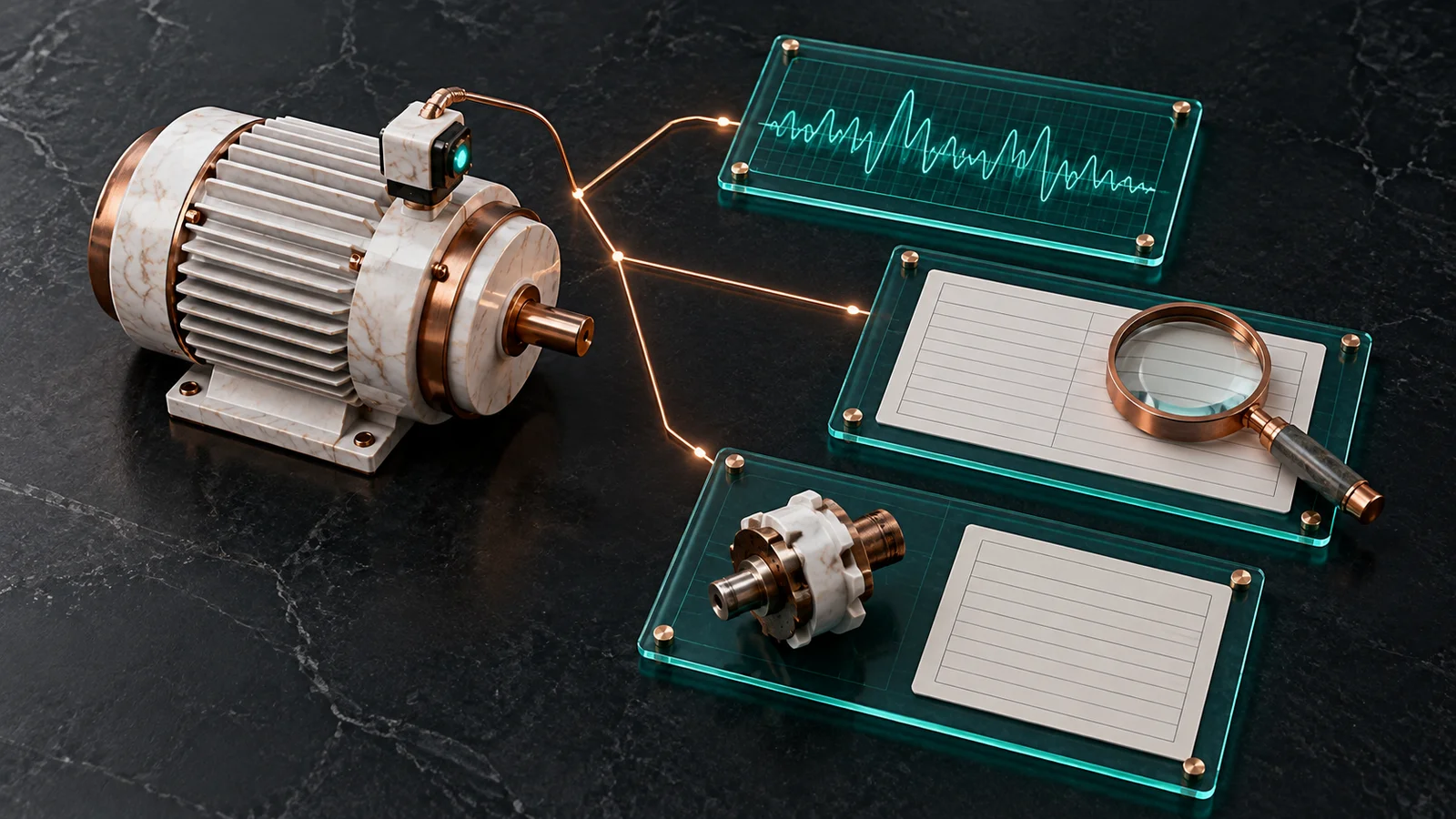
Predictive maintenance needs connected evidence, not simply more sensor readings. You need to know which equipment produced an observation, what it was doing, what condition changed, what an inspection found, what work actually happened and how the equipment behaved afterward. Missing links limit what anyone can conclude.
Start by tracing one maintenance event through those records. That exercise often reveals a more useful first investment than another dashboard: correcting an equipment identity, recording operating mode or making inspection findings available. A large measurement archive cannot supply a diagnosis that nobody verified.
Follow one event from observation to outcome
Hypothetical worked scenario
Consider drive motor M-07 on carton folder CF-07. A vibration change raises a question about motor mounting looseness, which could disturb folding consistency. These equipment names, records and findings are invented, not a client case. The exercise concerns maintenance evidence; existing guarding, protection and authorized work procedures remain authoritative.
The maintenance manager opens evidence packet EP-07 in the maintenance register, the system of record for the reviewed event. It links to the time-stamped measurement store and the original technician report. The packet references evidence rather than replacing the source records with a polished summary.
- Identify: installed motor and configuration.
- Contextualize: load, speed and operating mode.
- Observe: relevant condition and signal quality.
- Inspect: finding and examination scope.
- Intervene: actual completed work.
- Follow up: behavior and unresolved questions.
Ask the owner to locate each link before calling the history ready for prediction. An alert can start this chain, but it is not a diagnosis. A work order can organize an investigation, but its existence does not show what a technician found.
Identify what was installed when the record was made
A machine name is not enough when its motor, drive settings or sensor installation can change. Keep the parent machine, installed component and measurement point distinct. Otherwise, a replacement motor may inherit a predecessor's condition history as though nothing changed.
- Parent machine
- CF-07, the carton folder.
- Installed component
- M-07, with its serial reference and installation dates.
- Configuration
- Applicable drive setup, mounting arrangement and change record.
- Measurement point
- Named motor location, direction and sensor installation history.
For EP-07, the reviewer needs the configuration in force during the vibration observation, not just today's equipment list. Preserve when a change took effect and which records it affects. A sensor remounted in another direction can change a trace without demonstrating machine deterioration.
If an old service note says only “folder motor,” keep that association unresolved until someone can substantiate it. Do not attach it to M-07 because the name looks plausible. The equipment owner resolves identity conflicts; the analyst should not quietly invent a serial number or installation date.
Record the work the machine was doing
Load and mode explain why healthy equipment can produce different readings. For a carton folder, relevant context might include production versus setup, actual speed, stock type and whether material was passing through the machine. Record what is observed and distinguish it from a requested setting.
| Available record | What it establishes | Comparison limit |
|---|---|---|
| Production with known stock and speed | A described operating condition. | Check component and sensor configuration too. |
| Setup without cartons | An unloaded setup observation. | Not equivalent to loaded production. |
| Mode or load missing | Context remains unknown. | Do not silently classify it as normal production. |
NASA's data repository describes milling experiments with different speeds, feeds and cutting depths alongside recorded insert wear. That is a concrete example of operating conditions accompanying condition evidence, not proof that its experimental data represents this carton folder.
For EP-07, missing material context restricts comparison even when vibration is available. Keep the missing field visible. Reconstruct it only from an attributable production record, retaining who made the association and the basis for it.
Keep the meaning behind each condition signal
Select observations because they can inform a named failure question. Vibration may support a mounting investigation; motor current may add load context. Neither is a universal diagnosis. An unusual reading can reflect the equipment, process, sensor or collection method.
Keep units, measurement location, acquisition method, source time and quality status with the value. A vibration summary needs its calculation window and processing definition. Retaining an unexplained number called “health” makes later review harder, even if the display looks precise.
- Observation
- Changed vibration at the named motor point.
- Supporting context
- Operating mode, speed, stock and configuration references.
- Quality check
- Time basis, units, sensor status and processing definition.
- Interpretation
- Mounting looseness is a question for inspection, not an established cause.
The OPC Foundation's DataValue specification distinguishes a value, its status and source and server timestamps. It describes status as an indicator of value usability. Its source timestamp should indicate the last value or status change, not necessarily every measurement. OPC UA is an industrial data exchange standard; CF-07 is not assumed to use it.
A usable measurement still does not prove healthy equipment. Preserve missing or unusable observations as such rather than substituting zero, a remembered value or an invented “normal” result. Retain enough original evidence to revisit the interpretation.
Make findings more precise than “fault” or “no fault”
An inspection record should say what was examined, how, when, by whom and what the examination established. In this hypothetical event, the technician documents loose motor mounting fasteners. That supports a finding about the examined mounting, not every possible motor defect.
| Record wording | Meaning | Permitted interpretation |
|---|---|---|
| Looseness found | Documented examination supports the finding. | Confirmed within the recorded scope. |
| Looseness not found | A relevant examination found no looseness. | Negative finding for that examination. |
| “No fault” with no examination detail | Basis cannot be established. | Unverified label. |
| Not inspected | No examination outcome available. | Unknown, not a negative finding. |
In EP-07, a coupling insert is also replaced as a precaution during the visit, but no removed-part examination result is recorded. Replacement does not confirm a coupling fault. Keep its fault status unknown and the replacement reason separate from the mounting finding.
A negative finding applies to the recorded location, method and examination time. It does not establish that every component was healthy, or rule out a condition the inspection could not reveal.
Keep the original technician wording beside any reviewed category. A qualified reviewer can resolve ambiguous language or narrow the finding. An assistant may suggest a category with supporting text, but it must not turn an uncertain note into a confirmed failure label.
Link actual work to a comparable follow-up
A requested repair, a purchased part and completed work are different events. EP-07 should link the technician's completed-work record: the mounting was secured, alignment was checked and the insert was replaced as a precaution. Preserve the actual completion time and any changed settings or measurement setup.
- Finding: mounting looseness documented; insert fault unknown.
- Work: completed actions recorded individually.
- Observation: vibration changes after the visit.
- Review: compare operating context and retain alternative explanations.
Suppose the next vibration observation is lower, but comes from an unloaded setup run. Record it as a setup result. It does not establish recovery during production. The maintenance manager assigns a comparable production follow-up; its outcome remains pending until that evidence exists.
Even a later comparable improvement would not prove that the precautionary insert replacement fixed a confirmed insert fault. Multiple actions complicate attribution. Likewise, watching the motor without a known outcome does not establish predictive accuracy. This packet prepares evidence for later evaluation; it is not a model-performance result.
Use a readiness worksheet before expanding collection
Bring operations, maintenance and the data owner together around EP-07. Use this worksheet to distinguish evidence available for review from evidence still needed. Readiness belongs to a defined question, not to the size of the database.
| Evidence link | Check before use | Owner of a gap |
|---|---|---|
| Identity | Installed motor and configuration match the observation. | Equipment owner. |
| Operating context | Mode, speed and material context are attributable. | Operations lead. |
| Condition | Signal meaning and quality are retained. | Measurement owner. |
| Finding | Examination supports the label and its scope. | Qualified maintenance reviewer. |
| Actual work | Completion is evidenced, rather than inferred from a request. | Maintenance lead. |
| Follow-up | Comparable production observation is still pending. | Maintenance manager with operations. |
Conventional software can enforce identifiers and required fields. AI can locate referenced notes and flag contradictions. People retain finding approval, work authorization and return-to-service decisions. Incomplete analysis does not suspend existing maintenance or safety requirements.
EP-07 supports a mounting finding and documented work, but not a confirmed insert fault or verified production recovery. The maintenance manager records the missing production comparison, its assigned reviewer and a review date. A completed service visit does not close that evidence gap.
The immediate business value is a reviewable history intended to reduce repeated fact-finding and expose missing follow-up. No universal sensor count or number of months guarantees readiness. Finish one defensible event chain, name its remaining limits and use those gaps to decide what to collect next.