

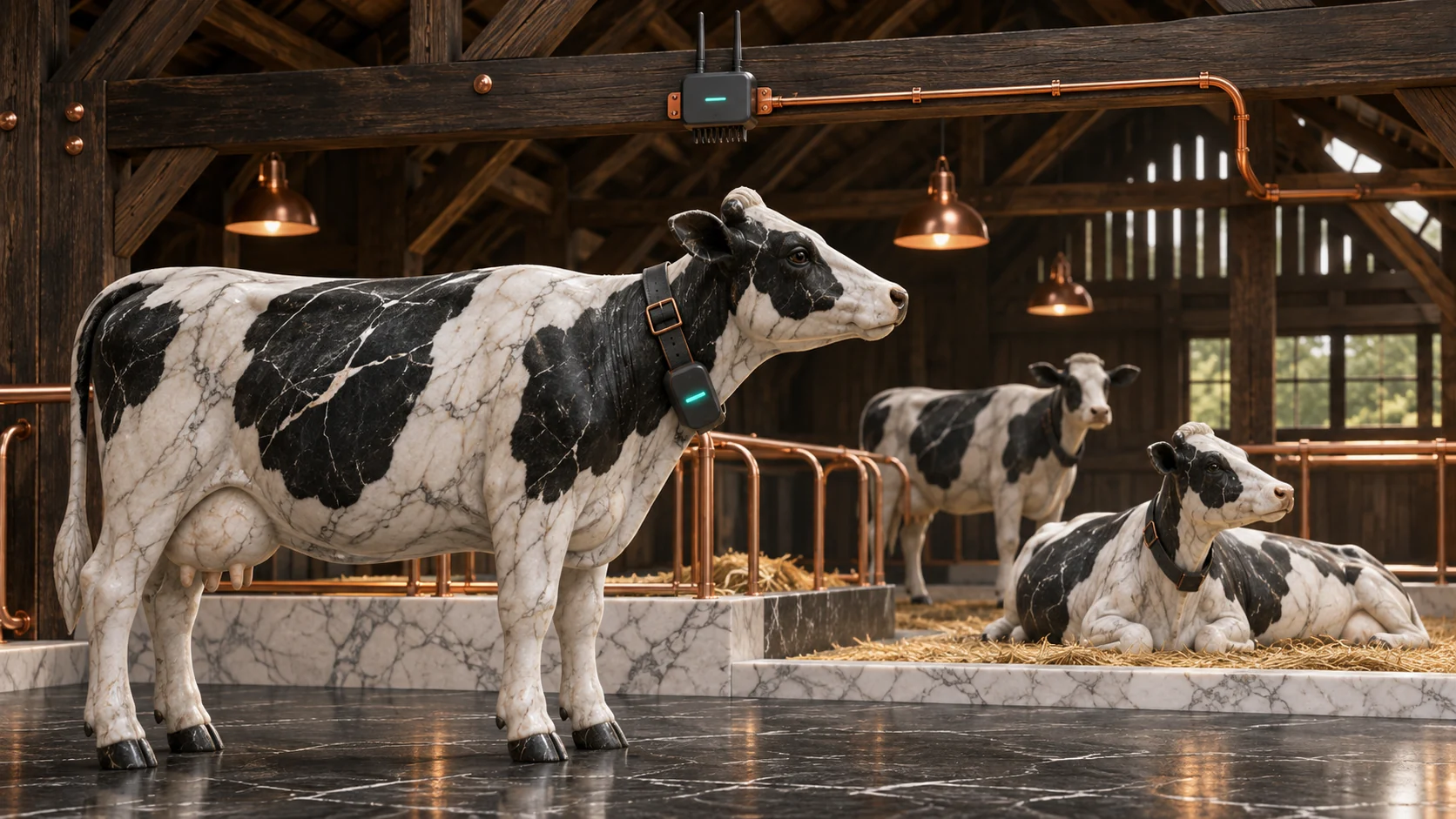
A dairy team needs two lists at the start of a shift: cows whose behavior changed and cows whose tags stopped reporting. Both deserve follow-up, but they call for different checks. Compare usable data with the individual animal’s baseline, and confirm the observation with the herd team before making a breeding or health decision.
This guide is for dairy managers, herd technicians, veterinarians and integrators evaluating collar, ear-tag or bolus data. Start with one group of animals, a supported sensor system, and a clear owner for both animal alerts and device faults.
Identify what the wearable actually measures
- Motion and activity. A three-axis accelerometer measures acceleration where it is worn. A loose collar, a changed mount, feeding and movement between pens can change the trace. Raw acceleration vectors do not directly measure rumination, estrus or illness. A validated vendor algorithm may use movement features and placement context to estimate behaviors such as rumination bouts or elevated activity.
- Temperature. A rumen bolus measures at its own internal location. Drinking can temporarily change the reading. An ear or surface sensor measures at a different site and may be more affected by fit and ambient conditions. Do not treat these as interchangeable core temperature readings. Verify sensor type, placement, drift checks and interpretation for the animal and device with the vendor and herd veterinarian.
- Animal context. Keep the stable animal ID, device assignment and effective time, model and firmware, and useful context such as pen or recent calving. A pen transfer, ration change, milking schedule or hot weather can affect behavior. Check whether several animals changed together before treating every alert as an individual event.
Penn State Extension’s dairy technology review describes the distinction between sensors and the algorithms that interpret them. Its purchase guide recommends testing whether the claimed behavior or change is measured reliably in the intended setting.
Build separate queues for animal observations and device faults
Start with the vendor’s approved alert rules and the animal’s recent history under comparable conditions. Keep the baseline version, expected reporting interval, and data coverage with each alert. Different models and placements may estimate different values. Establish a new baseline after a tag swap or a material change in fit or herd context. Ask the herd team how much reliable data is needed before an alert is worth reviewing.
An activity rise may support a follow-up for possible heat, meaning estrus. A sustained change in estimated rumination or activity may prompt a health check. Either signal is nonspecific. A veterinarian or trained herd worker should determine what to inspect and when to escalate. Staff should never treat missing packets as zero activity or low rumination, and the aggregator should not decide when to inseminate or diagnose mastitis. See Wisconsin Extension’s guidance on estrus observations and udder-health monitoring.
Send stale data, weak battery signals, lost tag assignments, and gateway gaps to a device-support queue with the last verified time. If an entire pen disappears at once, investigate the receiver or network and maintain manual checks. The herd team still needs a way to request a timely animal check when the technology is unavailable.
Design the receiver around the actual barn radio path
Begin with a supported vendor gateway, documented export or integration API. Confirm which devices, fields and timestamps the vendor supports. A tag might broadcast a limited identifier, exchange data only with its own gateway or use an encrypted or non-Bluetooth protocol. A receiver cannot derive clinical data from a radio packet that does not contain or authorize access to it.
An ESP32-S3 or ESP32-C6 can be evaluated for a supported Bluetooth LE scan. Espressif’s ESP32-S3 and ESP32-C6 feature tables list LE Coded PHY and advertising extensions. Match the exact tag and receiver firmware, advertising mode, PHY and supported payload. Coded PHY can improve reception under some conditions while taking longer to transmit equivalent payloads. It does not guarantee coverage. The Bluetooth SIG primer explains the tradeoff and distinguishes received signal strength from more capable positioning methods.
Use multiple receivers where the measured coverage calls for them. Metal fixtures, animal bodies, tag orientation and overlapping receiver footprints affect reception. A directional antenna can change coverage but a strongest signal is not proof of the cow’s location. Use receiver identity and signal strength to troubleshoot the link. Do not present them as precise triangulation. Test in occupied pens and along the actual milking and transfer routes.
For wired backhaul, both chip options can use a supported external SPI Ethernet controller. Neither provides native RMII Ethernet. A Power over Ethernet installation also needs suitable powered-device circuitry and the correct switch and protection for the site. See Espressif’s SPI Ethernet guidance. A wired backhaul avoids using Wi-Fi for transport on the same receiver, but still requires testing of BLE capture under realistic load. Buffer supported events with original measurement times and known sequence identifiers where available. When two gateways see the same vendor event, keep one event for the animal history and retain receiver evidence as separate diagnostics.
Read one worked shift with the right denominators
In this illustrative trial, 60 cows are enrolled. At the shift review, 54 have current usable reports and six are stale. Coverage is 54 of 60, or 90%. Four of the six stale tags last reported through the same receiver before its uplink stopped. The technician checks the receiver and the herd team keeps manual checks in that pen. The missing reports are not interpreted as animal behavior.
Nine of the 54 reporting cows have distinct follow-up alerts. The herd team records four for additional estrus observation under its protocol, two for a health check, and three for which an initial check finds no current action. That is six planned actions among nine reviewed alerts. It is not a diagnostic accuracy figure and cannot establish how many cows needing follow-up the system missed. Include scheduled manual observations of some animals without alerts if you need to estimate missed cases. Track how quickly the person responsible can review each alert before making a staffing or purchase decision.
Validate coverage, interpretation and daily handoff
- Pair signals with manual observations. Compare vendor outputs and trained observations at matched times across normal activity, feeding, milking, pen moves and hot conditions. Review representative animals and conditions with the herd manager and veterinarian. Record actions and uncertainty separately from the alert itself.
- Test the reception and identity failures. Disconnect a receiver, move an enrolled animal between covered areas, overlap receivers, and replace or reassign a tag. Verify that gaps, duplicates and conflicting assignments cannot create a behavior change. At realistic herd loads, measure percent of animals with timely data, missing intervals and recovery. Use that test to size the deployment.
- Assign owners and retention. Give herd staff the relevant animal and observation context. Give device support the receiver, tag and last-seen evidence. Track fit checks, battery replacement, sanitation, spares and firmware support. Limit detailed raw data and retention to what the operation needs, with approved access and export arrangements.
- Compare alternatives. Evaluate the supported vendor platform, a small aggregator or improved manual observations using the same coverage and follow-up measures. Include repeat checks, staff time, installation and maintenance. Assess herd outcomes using the operation’s verified records and veterinary oversight.
A useful pilot gives the herd manager a short list of animals to check and a separate list of devices to fix, with enough evidence to understand each decision.