

A remote sensor was purchased with a long battery-life expectation. A few months into the deployment, staff are replacing cells more often than planned, and every visit takes time. The immediate question is not whether the battery claim was dishonest. It is whether the installed device is operating under the assumptions behind that claim.
A practical power budget makes those assumptions visible. It connects the configured reporting behavior, actual current demand, battery limits, and maintenance plan. The result is a more defensible replacement decision, not a promise that a spreadsheet can predict the exact day a field device will stop working.
Find the assumptions behind the original estimate
Identify the exact device and firmware, enabled sensors, reporting interval, radio settings, battery type, environmental assumptions, and expected maintenance activity. A demonstration board and the deployed assembly may have different loads. A new firmware feature or more frequent reporting can also change what the device does between visits.
Keep the estimate's measurement boundary clear. Does it cover only a radio chip, the complete sensor, or the assembled device including regulator and peripherals? A component's low sleep current should not be described as the full installation's consumption.
Ask which activities were included. Initial joining, reconnection, repeated transmissions, diagnostics, indicator lights, and firmware maintenance may be occasional rather than continuous. They still need a justified allowance or an explicitly recorded exclusion when planning service life.
Measure states rather than rely on one average
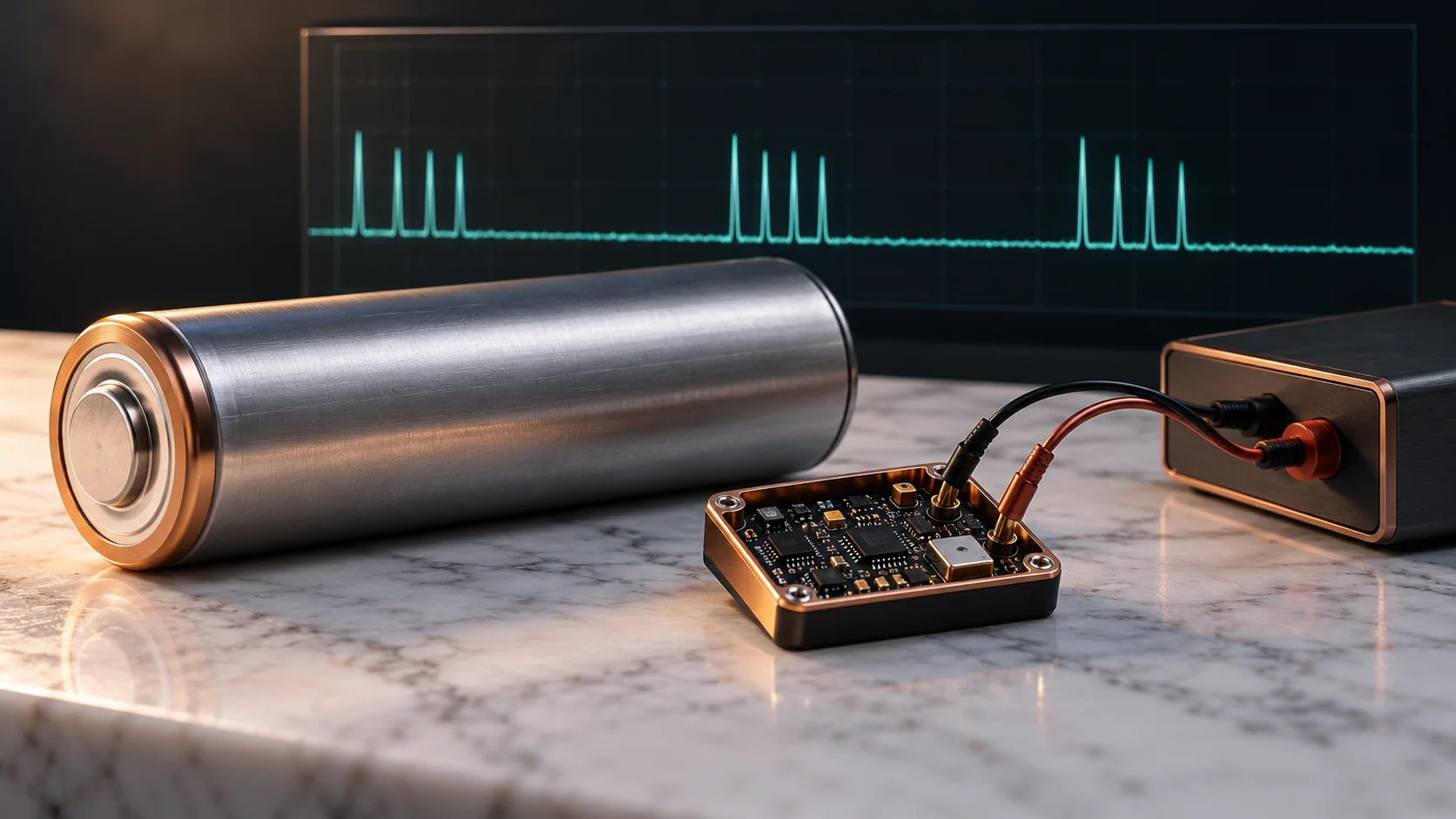
A device can spend long periods quiet and short periods measuring or communicating. A simple handheld reading may not characterize both the low background demand and brief active events. Use a suitable measurement setup under the manufacturer's instructions, with a qualified person checking the boundary and results.
Nordic Semiconductor's power-profiler documentation illustrates the need to observe low sleep currents, active currents, and short peaks. The principle is useful beyond one brand of equipment; the measurement method must suit the actual device.
Retain a current-over-time record and the operating event it represents. If a measured event already includes sensing, radio transmission, and recovery, do not add all three again as separate budget lines. Likewise, distinguish a current in milliamps from a charge in milliamp-hours. Combining those units as if they were the same can produce a plausible-looking but meaningless total.
Record the measurement point and supply voltage as well. Keep comparisons at the same electrical boundary, and have a technical reviewer resolve conversions before combining results taken at different supply points.
- List the statesIdentify quiet operation, sampling, transmitting, retrying, and maintenance activity.
- Measure the demandUse appropriate profiling equipment and record the full configured device.
- Compare scenariosCalculate daily charge for expected and observed event patterns.
- Review service lifeCheck battery limits, field evidence, replacement access, and a conservative maintenance plan.
Compare a normal day with a changed reporting pattern
Consider an illustrative sensor budget using invented inputs, not measured product specifications. Assume a full day at the quiet-state reference would consume 0.24 milliamp-hours. Each operating event adds a hypothetical 0.02 milliamp-hours above that already-counted baseline, including its incremental sensing and transmission activity. This baseline-plus-increment model avoids charging the same quiet-state time twice.
At 100 events per day, event consumption is 100 multiplied by 0.02, or 2.00 milliamp-hours. Adding the non-event allowance gives 2.24 milliamp-hours per day. If the event count becomes 200, the same simplified model gives 4.00 plus 0.24, or 4.24 milliamp-hours per day.
The example shows how changed event frequency can alter demand. It does not establish actual battery life, and it assumes event demand remains the same. If the radio behavior, payload, or retry pattern changes, the relevant event needs measuring again rather than blindly multiplying the old number.
The deployment owner can compare the observed reporting pattern with the approved monitoring need. Reducing transmissions may be a reasonable option for review, but not if it prevents timely detection of the condition the business intended to observe. A power-saving change needs an operating decision as well as an electrical calculation.
Separate consumption from usable battery capacity
Daily charge demand is only part of the question. The selected battery's usable capacity depends on its specifications and operating conditions. Temperature, load behavior, self-discharge, and the device's cutoff conditions can matter. Nordic's battery-estimation guidance identifies these limitations in its own Matter/Thread context; its example capacities and adjustment factors should not be copied into an unrelated deployment.
Use the actual battery manufacturer's documentation and appropriate field evidence. Do not assume that all nominal capacity is available, that a voltage reading directly indicates a fixed percentage remaining, or that every battery chemistry tolerates the same loads. A qualified reviewer should confirm battery suitability and safe replacement procedures.
If devices in one area fail earlier, preserve their location, configuration, installation date, battery lot where available, symptoms, and replacement findings. A communications failure or reset is not automatically proof of an empty battery. Keep the observed failure separate from the suspected cause.
Keep a worksheet that maintenance can use
A useful budget and service record includes:
- Device boundary: hardware, firmware, peripherals, power supply arrangement, and the configuration tested.
- Measured demand: quiet-state observations and active-event charge, with method, units, date, and original trace references.
- Operating scenarios: events per day, retry assumptions, maintenance events, and which states are included in each calculation.
- Battery evidence: exact battery type, relevant manufacturer limits, environmental assumptions, and the basis for usable-capacity estimates.
- Field observations: installation dates, symptoms, verified findings, replacements, and differences between areas.
- Decision: reviewer, planned inspection or replacement interval, uncertainty allowance, and triggers for re-evaluation.
Ordinary calculations and versioned records should own the arithmetic. AI can summarize logs, flag a changed reporting interval, or assemble an estimate for technical review. It should not choose a replacement chemistry, infer missing measurements, or silently extend the maintenance interval.
Start with a representative device and a location that is expensive to service. Compare the original assumptions with measured behavior and verified field findings. The most useful result may be a better configuration, a corrected battery choice, or simply an honest maintenance plan that includes the cost of reaching the device.
Sources & further reading
Primary references checked October 19, 2026. Examples are illustrative, not reported client outcomes.
- Nordic Semiconductor: Power Profiler Kit IIFirst-party description of measuring low sleep currents, higher active currents, and short peaks. The article is not a product endorsement or an instrument operating procedure.
- Nordic Semiconductor: Battery lifetime estimationMatter/Thread-specific estimation context and limits involving temperature, connected loads, self-discharge, and battery cutoff. Do not generalize its example capacities or derating percentages to other devices.