

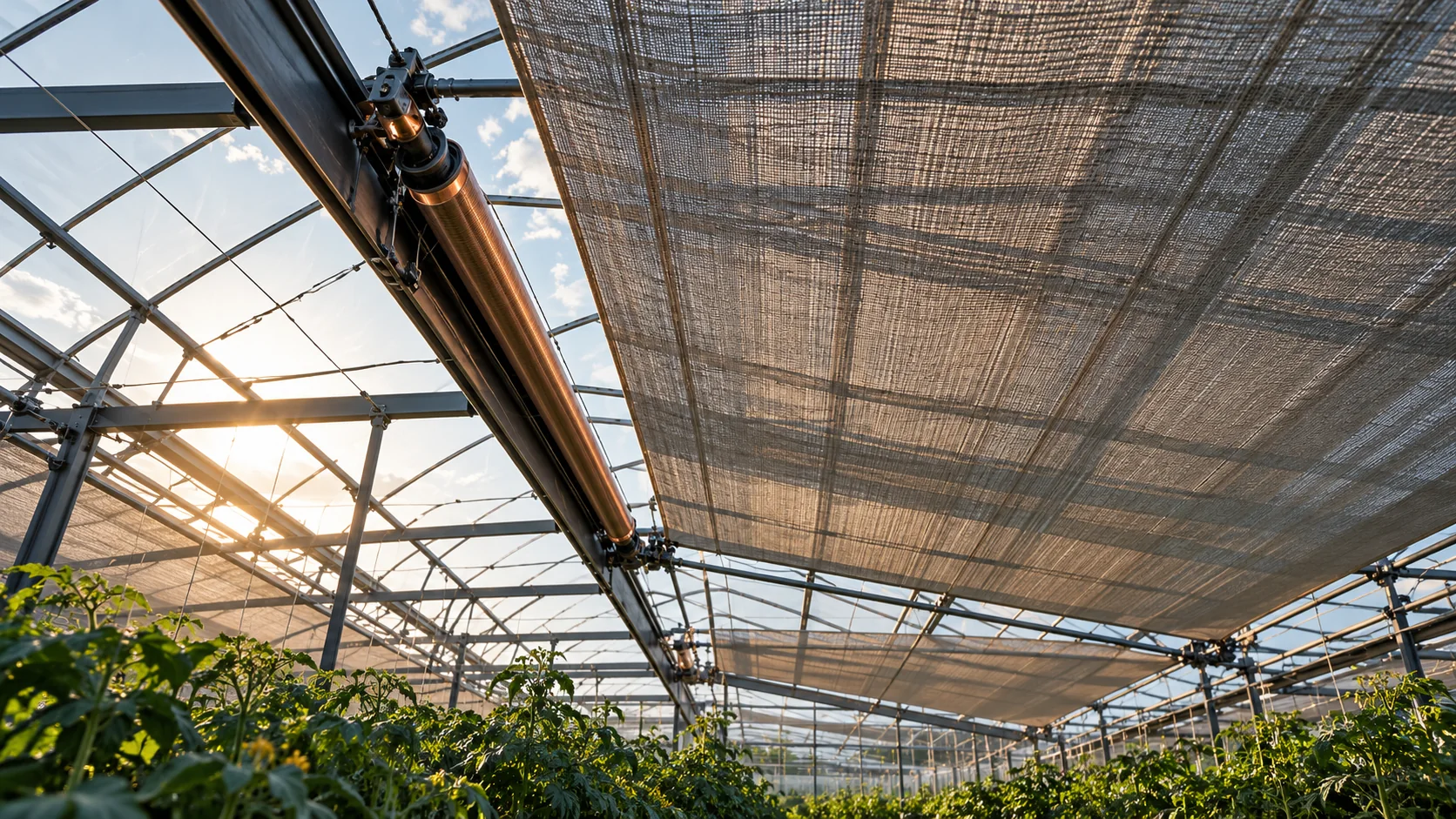
Keeping an energy screen closed longer can sound like a simple way to reduce heating demand. In a working greenhouse, the same change also alters the crop's surroundings. A lower fuel reading alone cannot tell the grower whether the new operating pattern is a good trade.
Evaluate a specific screen, deployment question, and crop context through an approved trial. Compare energy observations with light, humidity, equipment behavior, and crop checks. The objective is a decision with documented limits, not a universal opening time or a savings percentage borrowed from a different greenhouse.
Identify the screen and the proposed change
Energy and shade screens differ in material, purpose, permeability, installation, and control arrangement. Record the installed product and its current operating instructions before discussing what a screen does in general. A partially deployed screen may behave differently from a fully closed one.
UMass Extension's energy and shade screen fact sheet describes selection and operating considerations. Use that background to frame questions for the actual greenhouse and manufacturer, not to assume that one material or deployment strategy suits every crop.
Write the proposed change plainly. For example, the grower may want to compare the existing evening deployment with a later opening under defined conditions. That is a bounded operating question. Optimize the greenhouse is not a testable specification and leaves too much room for a system to change unrelated settings.
Compare periods that mean something
Heating use depends on more than screen position. Outside weather, wind, desired indoor conditions, crop stage, ventilation, and heating-system state can differ between periods. Record those differences before interpreting a lower meter total as the effect of the screen.
Choose appropriate energy measurement and comparison methods with the technical team. If the greenhouse shares a boiler or meter with another area, the available total may not isolate this trial. State that limitation rather than dividing the bill arbitrarily and presenting a precise saving.
Include observations the grower needs to protect the crop. Depending on the installation, these may concern available light, local humidity, condensation, crop response, and equipment operation. Establish the approved limits and a responsible person who can stop the trial. The article cannot supply crop-independent setpoints.
- Specify the screenRecord material, installation, actual state, and constraints.
- Bound the trialDefine one approved operating question and stop conditions.
- Compare the contextReview energy, weather, crop observations, and confounders.
- Decide the scopeRetain, revise, reject, or retest the proposed arrangement.
Work through a screen trial record
In an illustrative greenhouse, the manager considers extending screen deployment during an agreed part of the morning. The trial card is the source of truth for the proposed change; the climate controller retains the actual command and position history. A screen command is not assumed to prove that the mechanism reached its intended position.
The grower and equipment operator approve the trial scope, relevant crop checks, and stop conditions. The technician confirms what the energy and environmental systems can record. The comparison preserves the old schedule so an authorized operator can restore it if the trial must stop.
Suppose one hypothetical comparison window uses 900 energy units and another uses 810. The arithmetic difference is 90 units, or ten percent of the first window. That is an observed difference in this example, not an attributable screen saving: weather and operating conditions must still be evaluated. If the second window had substantially different outdoor conditions, the reviewer records the comparison as inconclusive for that claim.
Crop inspection also finds a local condition that needs review. The manager does not average it away because the energy total looks attractive. The trial pauses or changes only through the approved process. The final decision records whether to retain, revise, reject, or further test the proposed operating change and why.
Use a screen operation trial card
The card should include:
- Installation: screen material, house and crop, controller reference, position feedback, and manufacturer constraints.
- Question: the exact schedule or deployment change and the existing arrangement being compared.
- Context: weather, heating and ventilation state, crop stage, and other changes during the period.
- Evidence: meter scope and units, actual screen state, local environmental observations, and crop inspections.
- Limits: approved operating boundaries, stop conditions, responsible operator, and restoration reference.
- Decision: conclusion, unresolved confounders, approval, and any further observation required.
Preserve unsuccessful and interrupted windows. Removing a period because a mechanism did not behave as expected may hide the very operational constraint the business needs to understand. A trial interruption can be useful evidence without being counted as a normal operating comparison.
Let evidence constrain automation
Conventional controls should execute only approved settings and equipment protections. Ordinary reporting can align meter and position records. AI can summarize comparable periods and identify missing context, but it should not independently rewrite screen schedules or declare crop suitability from an energy chart.
Begin with a limited question that the existing measurements can answer. Where they cannot, improve the observation plan before expanding control. A worthwhile result may be discovering that a proposed saving cannot yet be isolated or that one crop-zone concern outweighs it. That clarity is more valuable than an impressive optimization claim that the greenhouse team cannot safely reproduce.
Sources & further reading
Primary references checked October 19, 2026. Examples are illustrative, not reported client outcomes.
- UMass Extension's energy and shade screen fact sheetPrimary background for the linked discussion. Use the actual application, current product documents, and qualified review for operating or acceptance decisions.